FACTORY
PHYSICS
Factory Physics is the scientific approach to operations management. Not another methodology — a set of physical laws that govern every factory on earth, regardless of industry, machines, or organisational culture. If you run a factory, these laws apply to you.
An article series based on Factory Physics for Managers — Hopp, Spearman, Jacobs — translated into the language of operational decision-making.
Laws, not opinions
Lean Manufacturing tells you what to eliminate. Factory Physics tells you why it works — and where Lean alone is not enough. That's the difference between a tool and the theory the tool is built on.
Factories have physical laws analogous to the laws of thermodynamics. You can ignore them — but you cannot break them. A manager who knows these laws makes different decisions than one operating purely on intuition and experience.
Three fundamental laws: the VUT Equation (Kingman, 1961) describes how variability and utilisation destroy flow. Little's Law ties WIP, cycle time, and throughput into a mathematical identity. The Three-Buffer Principle states that every factory absorbs variability through inventory, capacity, or time — and there is no fourth option.
Topics
Each article covers one chapter of Factory Physics translated into operational decision language — with examples, numbers, and concrete implications for production management.
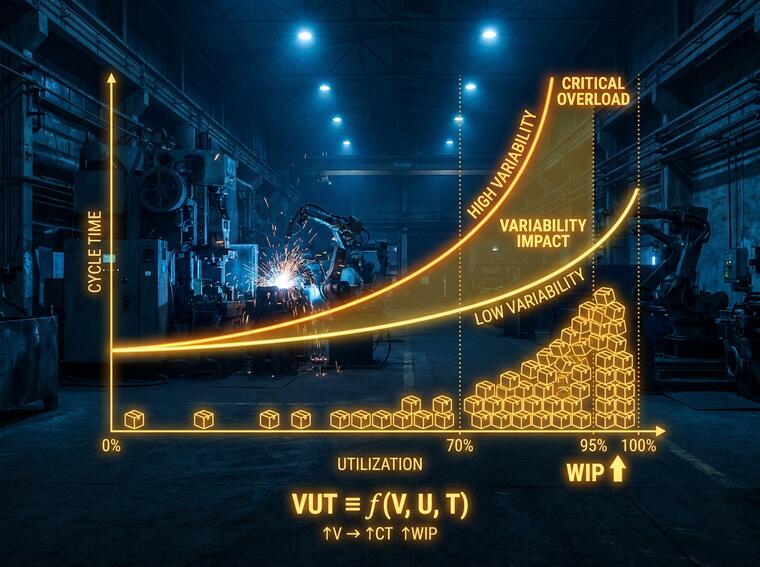
Kingman's VUT equation — why high utilisation exponentially destroys flow and how to calculate the damage before it shows up on the shop floor.
READ ARTICLEWIP = CT × Throughput. The mathematical identity that explains why limiting WIP is the only path to short, predictable lead times.
IN PREPARATIONInventory, capacity, time — every factory pays for all three. A deep analysis of buffer costs and buffering strategy in operational practice.
IN PREPARATIONConstant Work-in-Process — the pull system that works where classic Kanban fails. How to control WIP at the line level, not just the workstation.
IN PREPARATIONThe real benchmark is not "better than industry" — it's the best possible performance in your current environment. Factory Physics shows how to calculate it.
IN PREPARATIONWhy ERP/MRP systems systematically generate WIP overflow — and what to do when your planning system fights the laws of production instead of supporting them.
IN PREPARATIONYour factory
vs. physics
Want to see where your production stands against the laws of Factory Physics? We run a diagnostic — analysing VUT, WIP, lead time, and buffers in your specific environment.
BOOK A DIAGNOSTIC →